Drones Working the Vineyards

For centuries a dedicated vintner would walk the miles of his vineyards at least twice a year looking for irrigation leaks, failure or worse, blight and pestilence. Now he can do it from his favorite chair.
It's Fourth of July and Fruit- Bud Differential
Shorter days signal vines to cease tip growth and leaf production. Now the vines develop their fruit, store root energy for spring bud push and amazingly, they set the crop for next year's harvest in the canes. This may be the last irrigation for the season to keep the vines fit and stress free. .....And, of course, HAPPY
Roses along the Rows
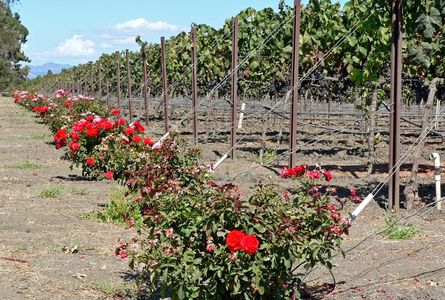
Is there a purpose to growing roses in a vineyard? Does it look pretty? Yes. Do they attract bees for pollination? Probably. The real function is that Roses are very susceptible to mildew which signals the vintner to treat his vines A.S.A.P. Today, however, spraying regimes and techniques are such that roses are not as essential as in the years past.
Cork Taint - 'Taint Good
It's an endemic problem in the Industry effecting roughly 1 in 100,000 corks with a compound of water, chlorine and mold (2-4-6 trichloroanisol) . Just 1 part per million can taint the contents of a bottle with the smell of wet dog or wet newspaper and it's undetectable until you pull the cork at your table. That's why each and every cork you extract from a bottle should be given a quick sniff for assurance. Besides you'll look so Sommelier-ish.
More Snapshots and Snippets
A Really Old Harvesting Tool
A Really Old Harvesting Tool
A Really Old Harvesting Tool

The Picking Knife was invented by the Romans. Today, 2500 years later, it remains the tool of choice for hand harvesting grapes throughout the world.
Important Numbers for A Wine
A Really Old Harvesting Tool
A Really Old Harvesting Tool
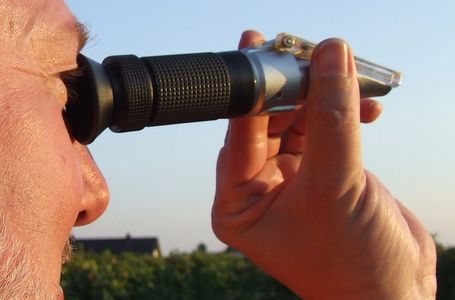
A refractometer bends light rays around solids and in ripening grapes, they are mostly sugar which fermentation will convert into equal parts ethyl alcohol and CO2. However there are additional solids in a grape - pulp, skin, seed, etc. Sugar x .55 (vs .50) = Alc OR 23.5 RS x .55 = 12.9% Alc .While one can't place this reading on a label, it gives the vintner an idea of the outcome.
Vines Hard at Work and Stressed
Vines are busy ripening their fruit. Berries turn color and become turgid. Inside, acid is respiring and natural sugars are building. The vintner picks when just enough acid remains and just enough sugar has developed for a wine that will achieve a perfect balance. This final stage in the vine's growing season is called Veraison, pronounced ver-eye-SAWN in French or VREY-zin in American English. It signals that harvest is near. The vine's lateral growth has been trimmed away so that grapes ripen evenly with full exposure to sunlight. Vintners are checking sugar levels almost daily because the harvest window is very narrow.
Every Wine Has A Halo
Look at the very edge of this tongue of wine, as it has something to say. Purple-ish = youth. Garnet or brick red = very drinkable (fruit). Tawny or onion skin = aged (complex). A wide clear halo = Watery wine or sulphur used to correct a wine. A story that meets the eye.
More Snapshots and Snippets
GET THAT THIEF!!
EL VENENCIADOR - QUITE A SHOW
EL VENENCIADOR - QUITE A SHOW
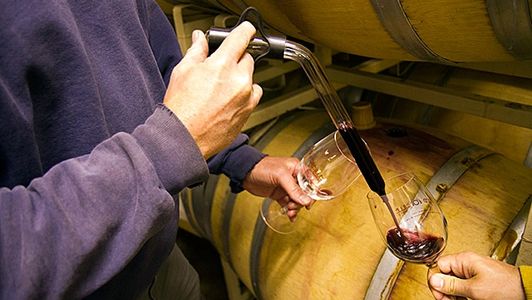
It takes a thief to get wine out of a barrel. This is a glass tube with an aperture at its pointed base and one at the top with an elbow or swan so the wine can be transported horizontally. The Winemaker submerges the tube into the wine and when a desired level is achieved, he/she places his/her thumb over the hole at the top and creates a vacuum keeping the wine inside, like a pipette. When over or in a desired vessel, the thumb is released and so is the wine. In wineries all over the globe, thieves are always good to have around.
EL VENENCIADOR - QUITE A SHOW
EL VENENCIADOR - QUITE A SHOW
EL VENENCIADOR - QUITE A SHOW
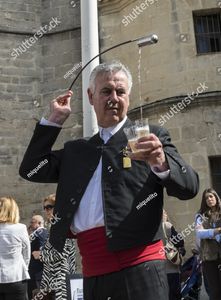
In Jerez de la Frontera in southern Spain, Sherry is produced by a dual fermentation - one producing wine and the second on the wine's surface producing the classic taste of Sherry. In order to sample the wine a special, flexible instrument is required to part the blanket of floating yeast and remove the sample before it reforms. It's called a Venencia and the skilled, flamboyant operator is the Venenciador (Salesman). Pouring from this three foot tool creates a 3 to 4 ft. stream to the waiting copitas (glasses) and he/she NEVER SPILLS A DROP!! So much fun to watch and the Sherry tastes .....oh so good. Olé!
MUSTARD BEYOND THE HOT DOG
The Wine Country in California naturally glows yellow in February and March as mustard proliferates and blossoms among the vines. The Spanish monks who explored and mapped California imported mustard seeds along with their grape vines because they knew this plant had properties to recharge soils. They were right. Mustard is rich in nitrogen and when disced under it fertilizes the soil. It is also a member of the Brassica Family (broccoli, cauliflour, chicory, etc.), as it organically drives away pests such as nematodes and the dreaded phylloxera (a root louse that wreaked havoc in vineyards across the globe.) Besides being pleasing to the eye, it's hard at work protecting the vines.
IT'S FOR THE BIRDS AND IT'S NOT GRAPES
Birds, craving sweetness to punctuate their monotonous diet, wait on wires or in trees at the perimeter of a vineyard to commute in and feast. It's not so much what they eat; it's what they destroy with their feet and their defecation. Vintners have a large arsenal of hazing weapons from lasers to propane cannons; from statues to kites to drones disguised as predators. In wide usage is flashing from mylar ribbons or strips attached to the vine.There was a vineyard that could be seen on a hill from mine that employed the mylar technique and my guests would ask: "What's going on in that flickering vineyard?" I would reply: "Oh, that's a vineyard producing grapes for SPARKLING WINE". If only you could see the expressions on their faces, especially when they figured it out.
More Snapshots and Snippets
Red, Yellow & Green - Stop at A Beautiful Autumnal Intersection
RED: A Fall leaf virus Red Leaf Mosaic. The vines are O.K.
YELLOW: No virus and no chlorophyll.
GREEN: Photosynthesis continues.
BROWN: Simple desiccation (drying).
CELESTIAL PAIRINGS #1 Fromage d'Affinois Brie and Champagne
Here's something for the Holidays or just about any festivity around your home. It's so Heavenly, that God would be proud of you. This Brie is the best French Brie to ever part my lips. The yeasty character of the Champagne and the bloomy, surface rind fermentation of the cheese creates a combined, microbial burst you have to taste to believe. Serve with crusty bread, crackers and any assortment of fruit - apples or pear
(Do I hear strawberry?) - and it will probably become a new aperitif of choice. Let's just say, it became mine.
COVER CROP - Beneficial Weeds for Vineyards?
Chemical fertilizers are not permitted in a vineyard certified Organic, so what grows between the rows must do the job each winter. Vintners analyze the soil for its deficiencies, aeration needs and erosion possibilities. Then they plant accordingly - crimson or yellow clover, various fescues, mustard, peas buckwheat, oats, etc. The old Italians planted fava beans (which actually deposit nitrogen into the soil rather than absorb it). In the spring they would harvest and enjoy them in pasta - Delicioso (or YUM!)
VINEYARDS: Snow & Ice Are Very Nice.
Great wines cannot come from hot climates, as vines would die from exhaustion. Night time freezing temperatures in double digits (20 - 30 degrees) keep vines dormant and resting without damage. It's the frosts that occur after spring bud break that wreak all the damage in temperate and even marginal zones. Some vintners delay pruning their early ripening varietals to keep vines dormant and dodge frosts for a couple of additional weeks.
More Snapshots and Snippets
NUTS OVER WINE

A little known but quintessential wine and food pairing is that of Pecorino Toscano & Chardonnay. While Pecorino is a darling cheese produced in different styles throughout Italy (La Pecora means “the sheep” in Italian), Toscano is a style that typically displays nutty characteristics which dance seamlessly with the barrel notes inherent in a barrel fermented / aged Chardonnay. You’ll simply know that they were created for one another once you’ve tried them together.
Where's the Silver?
Two main travel arteries run parallel down the length of Napa Valley from Calistoga to the city of Napa - HWY 29 along the base of the Mayacamas Mountains and the Silverado Trail along the Vaca Mountains on the Valley’s eastern flank. With almost 4 million tourists visiting Napa just last year (and trending younger - mean age of 40), many, if not most, have traveled the trail numerous times. I wonder how many innkeepers and hosts at Hospitality Centers have heard inquiries about how to see the mines. There are none for silver.
Actually the “silver” has more to do with gold. Called ”Quick Silver” because of the way it flows due to its density and viscosity; the substance was used to detach impure gold from slag during California’s historic Gold Rush. The substance was mercury and there were numerous mines in and around Napa, Sonoma and Lake Counties. The Silverado Trail was the route to Lake County on the other side of Mt. St. Helena which led to many mines around Clear Lake. Silverado was also the hideout for the author Robert Louis Stevenson (somewhere) on the flanks of Mt St. Helena.
Next time on the “Trail” think not of “quicksilver”, but more of the silver and gold in hundreds of medals awarded to the worthy wines along the way.
CHEERS!!
WINE AND FOOLS
Typical Vineyard in the Rhone Valley

God in His goodness gave us the grape to please both, large and small.
Little fools drink too much
Big fools, not at all.
No fools, O Lord are we
Who drink Thine nectar MODERATELY
........by Arthur C. Rota - My Dad
Typical Vineyard in the Rhone Valley
Typical Vineyard in the Rhone Valley
Typical Vineyard in the Rhone Valley
Many vineyards here have these baseball sized stones called Galet They reflect heat into the vines by day and radiate warmth at night.
Bud-Break
Typical Vineyard in the Rhone Valley
Detail your services
Vines 'awaken' around mid-March in Napa. This is a snapshot in late April when vines are stretching and yawning. Tiny grape clusters are already visible and preparing to blossom in May. The bees are putting on their flight jackets, helmets and goggles.
Detail your services
Typical Vineyard in the Rhone Valley
Detail your services
If customers can’t find it, it doesn’t exist. Clearly list and describe the services you offer. Also, be sure to showcase a premium service.
More Snapshots and Snippets
NUTS OVER WINE
A little known but quintessential wine and food pairing is that of Pecorino Toscano & Chardonnay. While Pecorino is a darling cheese produced in different styles throughout Italy (La Pecora means “the sheep” in Italian), Toscano is a style that typically displays nutty characteristics which dance seamlessly with the barrel notes inherent in a barrel fermented / aged Chardonnay. You’ll simply know that they were created for one another once you’ve tried them together.
Where's the Silver?
Two main travel arteries run parallel down the length of Napa Valley from Calistoga to the city of Napa - HWY 29 along the base of the Mayacamas Mountains and the Silverado Trail along the Vaca Mountains on the Valley’s eastern flank. With almost 4 million tourists visiting Napa just last year (and trending younger - mean age of 40), many, if not most, have traveled the trail numerous times. I wonder how many innkeepers and hosts at Hospitality Centers have heard inquiries about how to see the mines. There are none for silver.
Actually the “silver” has more to do with gold. Called ”Quick Silver” because of the way it flows due to its density and viscosity; the substance was used to detach impure gold from slag during California’s historic Gold Rush. The substance was mercury and there were numerous mines in and around Napa, Sonoma and Lake Counties. The Silverado Trail was the route to Lake County on the other side of Mt. St. Helena which led to many mines around Clear Lake. Silverado was also the hideout for the author Robert Louis Stevenson (somewhere) on the flanks of Mt St. Helena.
Next time on the “Trail” think not of “quicksilver”, but more of the silver and gold in hundreds of medals awarded to the worthy wines along the way.
CHEERS!!
WINE AND FOOLS
God in His goodness gave us the grape tp please both, large and small.
Little fools drink too much
Bog fools, notmat all.
No fools, O Lord are we
Who drink Thine nectar MODERATELY
Display real testimonials
Are your customers raving about you on social media? Share their great stories to help turn potential customers into loyal ones.
Display their FAQs
Customers have questions, you have answers. Display the most frequently asked questions, so everybody benefits.
Detail your services
If customers can’t find it, it doesn’t exist. Clearly list and describe the services you offer. Also, be sure to showcase a premium service.